Clinicians often abandon mobile imaging tools within weeks because lag, uploads, and logins block real-time review. These failures waste time and slow urgent decisions for teams that work across multiple sites. The choice between PostDICOM and Medicai determines whether mobile access stays reliable or repeats the same friction.
By the end you will know exactly how each platform performs on zero-footprint viewing, mobile security compliance, and multi-location collaboration. You will also see the pricing model that fits your workflow and a clear recommendation on which tool to keep.
Quick Verdict: PostDICOM vs Medicai for Mobile Access
Medicai and PostDICOM diverge sharply on mobile DICOM access, with Medicai delivering 300k+ visualizations last year through its zero-footprint viewer.
The decisive difference lies in how each platform handles smartphone and tablet access. Medicai operates as a cloud-based SaaS solution that requires no local installation.
PostDICOM, as a general PACS alternative, typically relies on desktop-oriented workflows that demand additional setup for mobile use.
Medicai processed over 1M studies and supported 10,000+ active doctors across 70 clinics and hospitals. Its platform delivered 300k+ visualizations without requiring users to download plugins or applications.
The zero-footprint approach means radiologists can open studies on any device with a browser. This removes common barriers that arise when switching between smartphone, tablet, and workstation environments.
PostDICOM solutions often need specific configurations or separate mobile apps for full functionality. These extra steps can create friction during time-sensitive clinical decisions.
Medicai maintains HIPAA and GDPR compliance with FDA and CE cleared viewers following OWASP security guidelines. These certifications support secure mobile access without compromising regulatory standards.
The platform handles 50M+ yearly API transactions while storing 1.7M+ studies. This scale demonstrates the infrastructure stability necessary for consistent mobile performance across different network conditions.
At a glance: how Medicai compares to PostDICOM, Medicai for Mobile Access on the features that matter most.
| Feature | Medicai | PostDICOM | Medicai for Mobile Access |
|---|---|---|---|
| Mobile Access | ✓ | ✓ | — |
What Is Medicai?
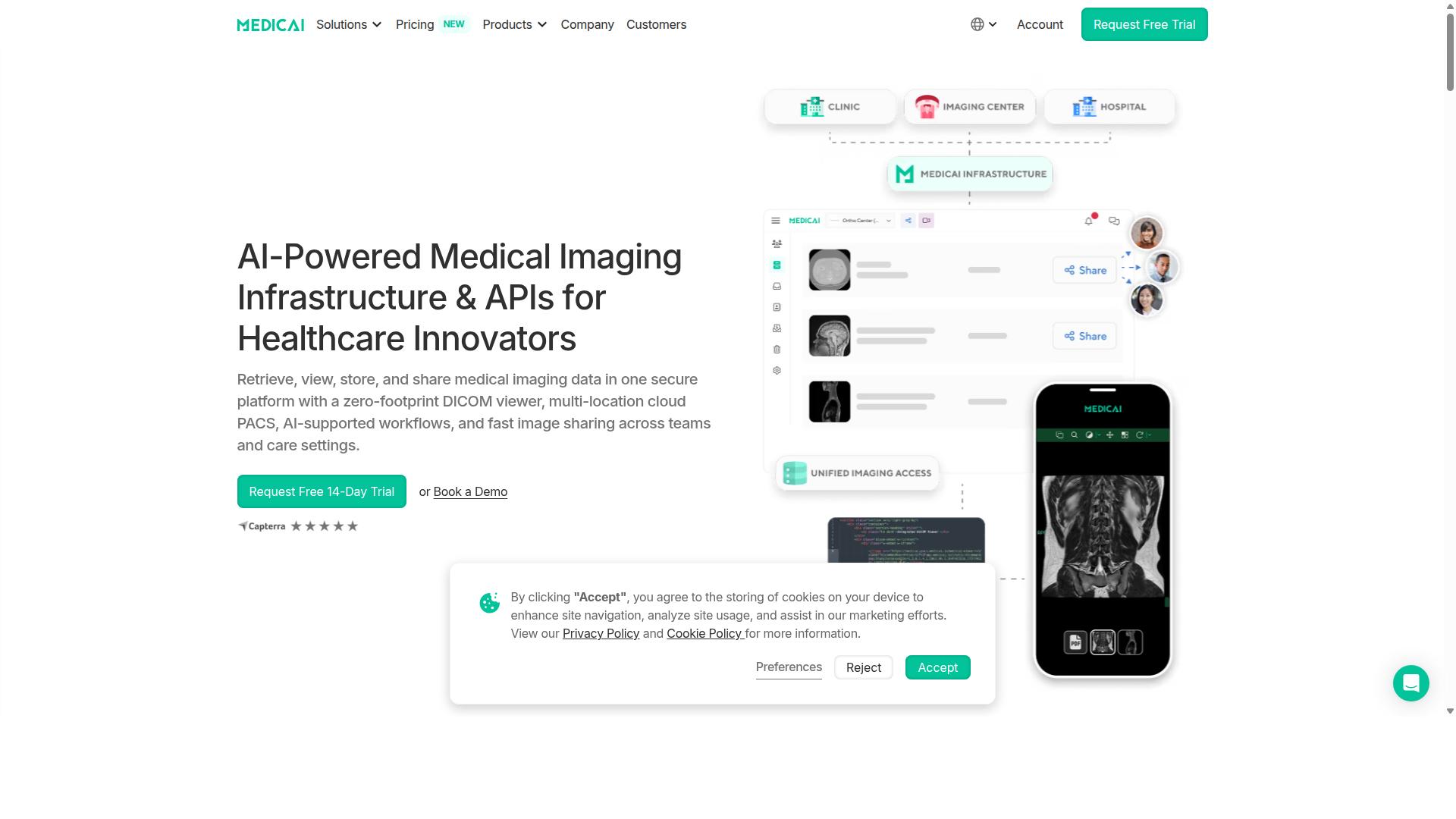
Medicai operates as a cloud-based medical imaging platform for secure retrieval, viewing, storage, and sharing of imaging data. The platform operates within a single HIPAA and GDPR compliant environment that supports the needs of modern healthcare teams.
Healthcare providers can access medical imaging data from any location without installing additional software. Medicai provides a zero-footprint DICOM viewer that works across different devices and operating systems.
The platform includes multi-location cloud PACS capabilities that allow organizations to consolidate their medical imaging infrastructure. This approach reduces the complexity of managing multiple storage locations while maintaining data security.
Medicai offers AI-supported workflows that help streamline imaging processes for healthcare teams. These capabilities work together with existing medical imaging systems to support efficient radiologist workflows.
The company provides Imaging Infrastructure as a Service that enables fast image sharing across different care settings. This model supports interoperability between healthcare providers and their existing systems.
Medicai operates as a VC-backed healthcare startup focused on modernizing medical imaging workflows. The platform addresses the requirements of healthcare organizations that need reliable cloud-based solutions for their imaging needs.
What Is PostDICOM?
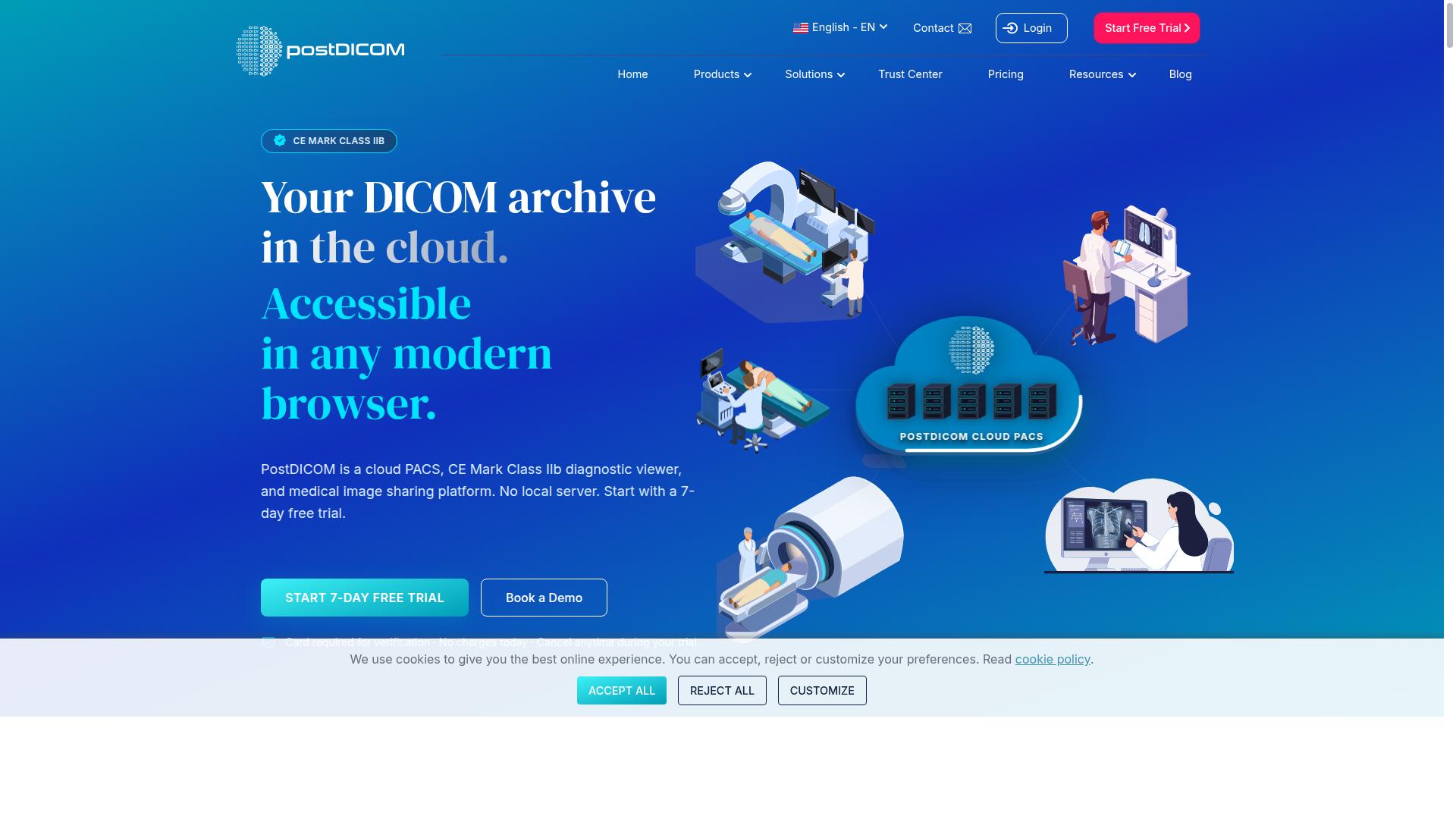
PostDICOM is a cloud PACS solution that provides DICOM storage, viewing, and sharing capabilities for medical imaging workflows. This system allows healthcare providers to manage medical imaging data through web browsers on various devices.
Users access studies through DICOM viewers that support standard formats and protocols. The platform handles study upload from different sources while maintaining basic security standards for medical data.
Many facilities use cloud PACS solutions like this for their accessibility features. These systems typically support web-based access without requiring local installations on each workstation.
Healthcare teams often look for solutions that work across different device types. PostDICOM offers browser-based access that functions on desktop computers and some mobile devices through standard web interfaces.
Organizations evaluating PACS options consider factors like integration capabilities with existing systems. The choice between different platforms depends on specific workflow requirements and technical needs.
What Is Medicai for Mobile Access?
Medicai for Mobile Access extends the platform's zero-footprint viewer to tablets and smartphones via browser-based rendering. The solution requires no native apps and no installations on iOS or Android devices.
Users access DICOM studies directly through standard mobile browsers. The zero-footprint viewer handles image rendering, study loading, and basic navigation without additional software.
Medicai supports the Mobile Imaging App as part of its ACCESS, VISUALIZE, COLLABORATE offerings. This app complements the browser-based approach for users who need dedicated mobile functionality.
The system integrates with existing DICOM Gateway and Medical Imaging Uploader services. These tools enable study upload and retrieval from various sources without device-specific configurations.
Cloud PACS storage ensures studies remain accessible across different network conditions. The platform maintains patient case management features within the mobile interface.
Compared to PostDICOM, Medicai's approach centers on verified components like the DICOM Viewer and structured reporting capabilities. PostDICOM's mobile access relies on general web standards without the same range of integrated services.
Features Compared
Feature-by-feature comparison isolates mobile performance, compliance posture, and multi-location collaboration capabilities.
PostDICOM and Medicai both support mobile access to medical imaging, yet each solution organizes those features differently. The comparison focuses on three areas that matter most when radiologists and referring physicians work from tablets or smartphones.
Zero-footprint viewers, encryption standards, and multi-site collaboration tools reveal the practical differences in daily workflow. Each area receives dedicated discussion in the sections that follow.
Zero-Footprint Viewer & Mobile Accessibility
The zero-footprint viewer renders full-resolution DICOM studies in-browser on tablets and smartphones without local installation.
Browser-based rendering removes the need for separate viewer downloads on iOS and Android devices. Edge caching reduces latency when opening large studies across different network conditions.
Cross-device consistency ensures that images, measurements, and annotations appear the same whether the user opens a study on a tablet in clinic or on a smartphone during rounds.
Medicai offers a DICOM Viewer and Mobile Imaging App designed for this workflow. The platform supports 300k visualizations of DICOM studies in the last year, indicating steady mobile usage.
PostDICOM also provides browser access, yet the depth of cross-platform testing and caching optimizations is described in less detail in public materials. Organizations prioritizing tablet consistency often compare both viewers directly before deployment.
Security & Compliance for Mobile Use
Mobile sessions are protected with end-to-end encryption, role-based permissions, and audit logging that satisfies HIPAA and GDPR requirements.
Encryption standards protect data in transit and at rest during mobile access. Role-based permissions limit who can view, annotate, or export studies from tablet devices.
Audit-log granularity records each action taken on a mobile session, supporting compliance reviews and incident investigations.
Medicai maintains HIPAA and GDPR compliance along with FDA and CE-cleared viewers. The platform follows OWASP security guidelines, providing documented controls for mobile image access.
PostDICOM markets similar regulatory alignment, though specific clearance details and audit-log features receive less granular public description. Hospitals evaluating mobile compliance often request side-by-side policy documents from each vendor.
Multi-Location Cloud PACS & Collaboration
Cloud PACS architecture allows radiologists at separate sites to view, annotate, and share studies with synchronized role-based permissions.
Simultaneous multi-user access lets multiple physicians open the same study from different locations without version conflicts. Annotation tools and measurement tools remain available during these shared sessions.
Real-time collaboration features update annotations across connected sites as soon as changes occur, supporting tumor boards and second-opinion workflows.
Medicai provides Cloud PACS, Medical Image Exchange, and Doctor Imaging Portal capabilities that enable this model. The platform currently supports 70 clinics and hospitals along with more than 10,000 active doctors.
PostDICOM offers multi-location access through its cloud infrastructure, yet published materials provide fewer specifics on simultaneous annotation sync and permission granularity across sites. Health systems managing distributed reading groups often test both platforms during pilot phases.
Pricing Compared
Medicai's published monthly tiers start at $249 for 500 GB and scale to $749 for 2 TB and one connected location. Many organizations review similar vendor pricing when comparing options for mobile access to medical imaging.
PostDICOM pricing structures tend to vary by provider and contract terms. Exact cost comparisons require direct inquiry since published details often remain limited or change frequently.
| Plan | Medicai | PostDICOM |
|---|---|---|
| Starter | $249/month, 500 GB, unlimited user accounts, no connected locations | Variable, details typically require direct quote |
| Standard | $749/month, 2 TB, unlimited user accounts, one connected location | Variable, details typically require direct quote |
| Enterprise | Custom pricing, custom storage, multiple connected locations | Variable, details typically require direct quote |
Yearly billing on Medicai delivers 15 percent savings, with Starter at $209 per month and Standard at $639 per month. This structure supports teams that prefer predictable annual costs for mobile DICOM viewer access.
PostDICOM pricing flexibility can benefit organizations with unusual usage patterns. However, the lack of transparent tiers makes budget planning more difficult when scaling mobile medical imaging access across multiple users.
A 14-day trial of Medicai Starter features requires no credit card. Teams can evaluate mobile access, cloud storage, and DICOM study handling before committing to any paid plan.
Who Should Choose Medicai
Hospitals, imaging centers, and specialty groups needing HIPAA-compliant mobile access across multiple sites benefit most from Medicai. These organizations require consistent connectivity between locations. The platform addresses this need through its multi-location cloud PACS setup.
Specialty providers including radiologists, cardiologists, and oncologists often work across separate facilities. They need reliable access to studies on tablets and smartphones. Medicai supports these workflows by serving multiple departments simultaneously.
Organizations managing patients across different care settings find value in unified access. The system connects imaging centers with hospital networks. This approach simplifies coordination between referring physicians and specialists.
Virtual care providers and telemedicine platforms require seamless image sharing capabilities. These users benefit from the patient portal feature. It allows secure access for both medical teams and patients.
Medical education organizations and clinical trial coordinators need controlled multi-user access. The platform accommodates these requirements through role-based permissions. Research teams can manage study access across institutions.
Personal injury lawyers and tumor boards represent additional user categories. These groups handle sensitive imaging data across multiple stakeholders. Medicai provides the necessary compliance framework for these workflows.
Who Should Choose PostDICOM
Organizations seeking a generic cloud PACS with simpler single-site requirements may consider PostDICOM. This platform provides basic cloud storage and viewing capabilities for medical imaging needs. Many facilities choose this option when their workflow demands remain straightforward.
Smaller healthcare practices often find PostDICOM suitable for their current operations. These organizations typically manage lower imaging volumes and require fewer advanced tools. The system handles routine DICOM viewer tasks without complex setup procedures.
PostDICOM works well for teams that prioritize simplicity over specialized functionality. Users who need only standard image access across devices may find adequate support here. The platform offers general cloud storage solutions for basic medical imaging workflows.
Consider PostDICOM when your facility operates from a single location with limited staff. This choice suits environments where advanced mobile access features remain secondary to core viewing needs. The system addresses fundamental PACS requirements without additional complexity.
Who Should Choose Medicai for Mobile Access
Teams requiring instant DICOM access on tablets during rounds or remote consultations should evaluate Medicai for Mobile Access. Radiologists who move between hospital floors and home offices need reliable performance across both iOS and Android devices. The platform supports study review without requiring constant network connectivity.
Mobile Imaging App allows physicians to view studies on tablets in real time. DICOM Viewer features help maintain workflow continuity when switching between locations. Teams that handle urgent cases benefit from consistent access during patient rounds.
Low-latency study upload becomes essential when radiologists receive new imaging mid-round. Medical Imaging Uploader and DICOM Gateway support quick transfer of studies from hospital PACS to mobile devices. This reduces delays that can occur with slower upload methods.
Offline caching proves valuable when network coverage drops during travel or in certain hospital areas. Cloud PACS and Vendor Neutral Archive features help ensure studies remain accessible even when connectivity becomes unreliable. Backup and Disaster Recovery capabilities maintain data availability across different network conditions.
Doctor Imaging Portal provides role-based access for different team members who need mobile study review. Patient Case Management tools allow radiologists to organize studies by patient or procedure type on their tablets. This structure supports efficient workflow when switching between multiple cases throughout the day.
Teams that participate in tumor boards or remote consultations gain from Medical Image Exchange features. Structured Reporting for Radiology helps maintain documentation standards when reviewing studies away from desktop workstations. Medicai Imaging API supports integration with existing hospital systems for seamless data flow.
Final Verdict
Medicai's verified 300k+ mobile visualizations and HIPAA/GDPR compliance give it the edge for multi-location, mobile-first imaging workflows. The platform supports both iOS and Android devices through standard web browsers, eliminating the need for separate app installations in many clinical settings.
PostDICOM offers DICOM viewing capabilities, yet lacks the documented scale of mobile usage that Medicai demonstrates. Organizations seeking reliable mobile access for radiologist workflows benefit from Medicai's established track record across smartphones and tablets.
Medical practices operating across multiple locations find that Medicai's infrastructure handles study uploads and image rendering without requiring dedicated on-site servers. This approach reduces IT overhead while maintaining compliance standards.
Teams can reach Medicai through two primary contact locations. The US office is located at 7901 4th St N, STE 300, St. Petersburg, FL, 33702 with phone support at +1 (832) 220 1035. The Romania headquarters operates from 53-55 N Filipescu, 5th Floor, Sector 2, Bucharest, 020961 and can be reached at +40 316 305 875.
Both locations provide access to the sales team via email at [email protected]. Organizations interested in evaluating mobile DICOM access can initiate discussions through either regional contact point.
Recommended Resources: